Engineering Summary
- BT30 identifies the tool-holder interface path, but it does not define spindle power, torque, body diameter, maximum speed, bearing arrangement, cooling, or electrical configuration.
- Read power, rated torque, rated speed, knee speed, maximum speed, pole count, voltage, and frequency as one operating system instead of isolated numbers.
- Mechanical fit can eliminate a spindle before performance is considered: the current BT30 range uses 100 mm and 125 mm body platforms with different overall lengths.
- Use the specification sheet to eliminate incompatible configurations first, then compare suitable BT30 models by the machining load and speed path.
A BT30 spindle specification sheet can look simple at first: BT30, 3.5 kW, 24,000 RPM, 100 mm body, water cooling. The problem is that those values answer different engineering questions. If they are read as one marketing headline, it is easy to select a spindle that fits the tool holder but misses the machine envelope, speed path, torque requirement, or electrical configuration.
The safest way to read BT30 spindle specifications is to separate the tool interface from the spindle itself. BT30 tells you which holder family the spindle is built around. It does not automatically tell you how much power the motor has, how much torque it is rated for, how large the body is, what bearings are used, how the motor is wound, or which speed range is available.
This guide shows how to read those fields in a practical order. The examples use current ATC-Spindle.com BT30 configurations so that each specification can be connected to a real product rather than treated as an abstract definition.
Start with the key distinction: BT30 is only one part of the specification
A buyer may see two products described as “BT30 spindles” and assume they are close substitutes. That assumption is unsafe. The BT30 label identifies the tooling interface path, while the rest of the datasheet describes the motor, mechanical platform, electrical setup, and operating envelope.
| Specification field | What it tells you | What it does not tell you |
|---|---|---|
| BT30 tool holder | The spindle is built around a BT30 tool-holder interface | Power, torque, body size, speed range, bearing arrangement, or cooling |
| Power | The motor output class | Whether the spindle fits your machine or produces the required performance at your working RPM |
| Rated torque | A torque reference for the product configuration | The complete cutting capability without considering speed, cutter, material, and duty |
| Rated speed | A rated operating-speed reference | The highest speed the spindle can reach |
| Knee speed | The transition point used in the motor performance definition | The full usable process range by itself |
| Maximum speed | The upper speed limit of the variant | Whether that speed is useful for your cutting process |
| Body diameter | The main cylindrical mounting envelope | Overall length, nose geometry, connector clearance, or Z-axis capacity |
| Bearings | The bearing arrangement used by that spindle platform | Complete spindle accuracy, life, or application suitability by itself |
| Cooling | How the spindle removes heat | Whether the complete cooling loop is correctly sized and installed |
If you are still deciding which BT30 platform fits your machine, use this guide to understand the fields first, then review the current BT30 ATC spindle range with the incompatible configurations already removed from your shortlist.
BT30 spindle dimensions: check mechanical fit before comparing power
Mechanical fit should be checked early because a spindle that cannot be mounted correctly is not a candidate, regardless of its power rating.
The current BT30 range uses two main body platforms. The 100 mm platform covers the Basic 3.2 kW spindle and the 3.0 kW and 3.5 kW Model A and Model B products. The 125 mm platform covers the 5.5 kW and 7.5 kW Model A and Model B products.
A representative 100 mm product, the Model A BT30 3.5 kW spindle, lists a 100 mm body OD and a 388 mm overall length. A representative 125 mm product, the Model B BT30 5.5 kW spindle, lists a 125 mm body OD and a 465 mm overall length.
Those two values already change the installation decision. Moving from a 100 mm to a 125 mm platform changes the clamp or mounting arrangement. The longer spindle also changes the available Z-axis envelope and the space required around the spindle body.
When reading BT30 spindle dimensions, check the body diameter and overall length together. If the datasheet also provides nose diameter, front length, body length, cable exit, or connector geometry, use those values to confirm the complete installation envelope.
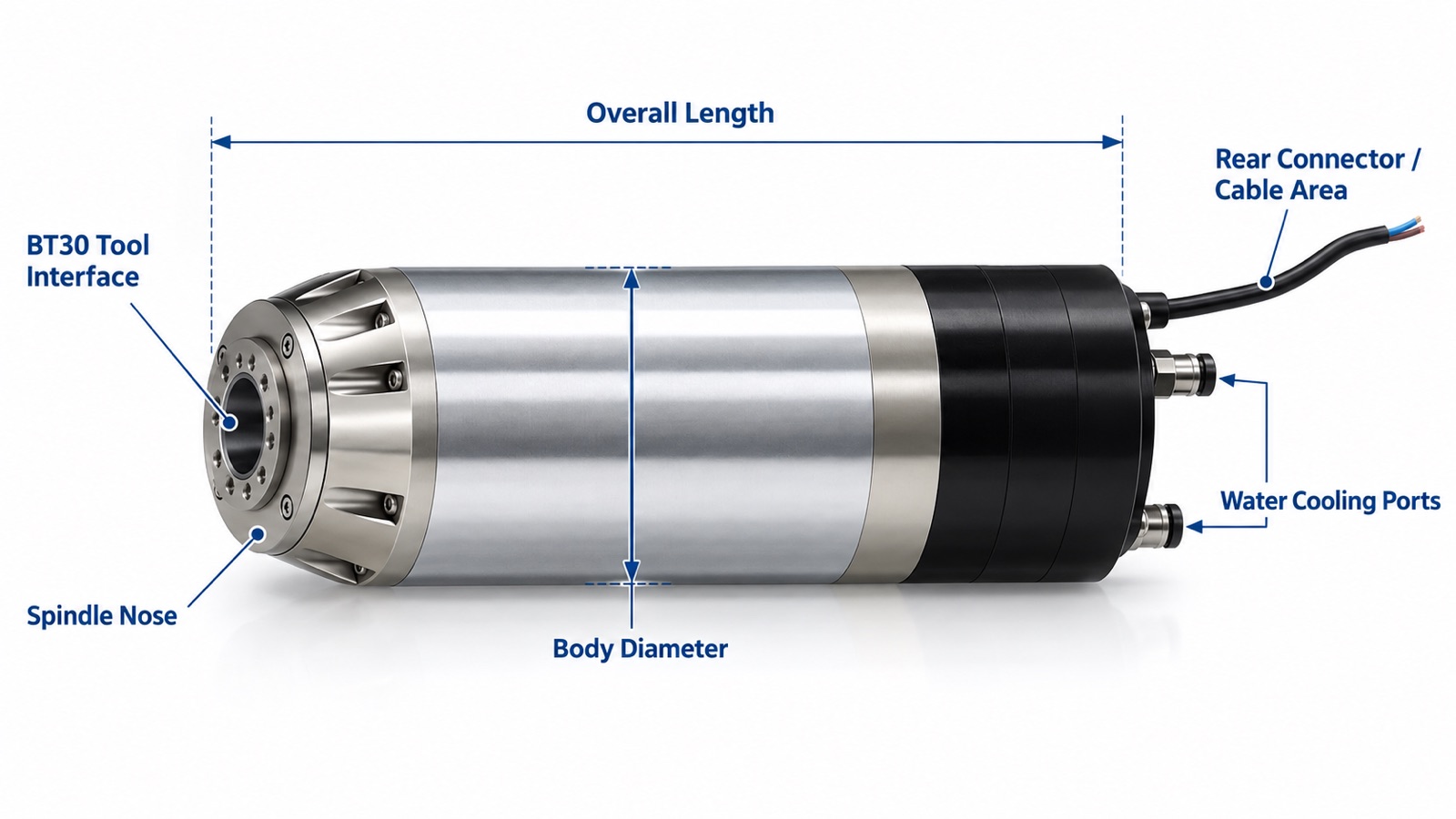
The dimensional drawing should help answer one question: will this exact spindle platform fit the real machine without forcing an unplanned mechanical change?
Read power and rated torque together
Power is one of the first numbers buyers compare, but power alone is a weak filter. In the current BT30 range, power classes run from 3.0 kW to 7.5 kW, with a 3.2 kW Basic model between them. Rated torque references increase across the range as well.
The current product data includes these examples:
| Representative configuration | Power | Rated torque | Body |
|---|---|---|---|
| Model A BT30 100 mm | 3.0 kW | 3.2 Nm | 100 mm |
| Model A BT30 100 mm | 3.5 kW | 4.0 Nm | 100 mm |
| Model B BT30 125 mm | 5.5 kW | 5.6 Nm | 125 mm |
| Model B BT30 125 mm | 7.5 kW | 7.6 Nm | 125 mm |
The useful comparison is therefore not “3.5 kW or 5.5 kW?” in isolation. The useful comparison is whether the machine can accept the related body platform, whether the listed torque is appropriate for the intended load, and whether the required performance occurs inside the intended speed range.
A higher power number should not automatically win. If a machine is designed around a 100 mm spindle mount and the process fits a 3.5 kW, 4.0 Nm configuration, moving to a 125 mm 5.5 kW spindle creates a different mechanical installation. If the process genuinely needs the 125 mm platform and 5.6 Nm rated torque reference, then the larger model becomes relevant.
For a deeper comparison of body platform and power class, use the existing ATC spindle power and body size guide. This article stays focused on how to read the datasheet correctly.
Maximum RPM is only one speed number
A common comparison mistake is to put two product pages side by side and look only at the largest RPM number. The current BT30 product data shows why this can be misleading.
The Model A BT30 100 mm 3.5 kW product is available with 4-pole and 8-pole variants. Its product data separates rated speed, knee speed, and maximum speed.
For 4-pole variants, the rated speed and knee speed are listed at 12,000 RPM. Depending on the selected 4-pole version, maximum speed is 18,000 or 24,000 RPM.
For the 8-pole 220V variant, rated speed and knee speed are listed at 6,000 RPM, with a maximum speed of 18,000 RPM. For the 8-pole 380V variant, rated speed and knee speed are listed at 12,000 RPM, with a maximum speed of 18,000 RPM.
This means that “3.5 kW BT30 spindle” does not describe one speed behavior. Even within the same power class, voltage and pole count change the rated-speed and frequency path.
When comparing two spindle specifications, ask three separate questions. Where is the rated operating point? Where is the knee speed? What is the maximum speed of the exact variant being quoted? A 24,000 RPM maximum can be useful, but it should never replace the other two questions.
Pole count, voltage, and frequency belong on the same line
Pole count is easy to overlook because buyers often treat it as a motor detail that can be checked later. In the current BT30 range, 4-pole and 8-pole variants can have different rated speeds, knee speeds, and frequency requirements. That makes pole count part of the spindle-selection decision.
Using the Model A BT30 3.5 kW data as an example, the 4-pole version lists a rated frequency of 400 Hz. The 4-pole 18,000 RPM version lists a maximum frequency of 600 Hz, while the 24,000 RPM version lists 800 Hz.
The 8-pole versions use a different path. The 220V 8-pole configuration lists 400 Hz rated frequency and 6,000 RPM rated and knee speed. The 380V 8-pole configuration lists 800 Hz rated frequency and 12,000 RPM rated and knee speed. The listed maximum frequency for the 8-pole path is 1,200 Hz, with a maximum speed of 18,000 RPM.
The purchasing lesson is simple: do not quote only power, voltage, and maximum RPM. Quote the exact pole configuration as well. Then confirm that the VFD and control setup can support the required rated and maximum frequency.
This is one of the clearest examples of why a complete specification sheet is more useful than a short product title.
Bearings and lubrication describe the spindle platform, not the whole result
Bearing information matters because it identifies part of the mechanical platform. It should still be interpreted as one piece of the specification.
The Model A BT30 100 mm 3.5 kW product lists two 7007 front bearings and one 7005 rear bearing. The Model B BT30 125 mm 5.5 kW product lists two 7008 front bearings and two 7006 rear bearings. Both list grease lubrication.
The important point is the change in complete platform. The 5.5 kW example has a larger 125 mm body, a longer overall length, a higher rated torque reference, and a different bearing arrangement. Comparing only “bearing model” would miss the rest of that system.
Use bearing configuration to understand how two spindle platforms differ, then keep it connected to body size, speed path, power, torque, and the product’s intended position in the range.
If your question is specifically about BT30 taper fit, pull studs, retention, or runout, use the separate BT30 taper specification guide. Those interface details deserve their own compatibility check and should not be mixed into the motor specification as if they were the same decision.
Cooling is a required integration field
Every spindle in the current ATC-Spindle.com BT30 catalog is listed as water cooled. That makes cooling easy to recognize, but it should still be treated as an engineering requirement.
“Water cooled” tells you the spindle needs an operating cooling loop. It does not, by itself, confirm the pump, chiller, coolant routing, flow monitoring, ambient conditions, or maintenance plan.
For specification comparison, cooling therefore acts as a compatibility field. If the machine does not already have the required cooling infrastructure, that work belongs in the installation plan before the spindle is ordered.
Cooling also illustrates a broader rule for reading datasheets: a specification can be correct and still be incomplete as an installation decision.
A real comparison: 3.5 kW 100 mm versus 5.5 kW 125 mm
Consider two current BT30 configurations.
The Model A BT30 100 mm 3.5 kW spindle lists a 100 mm body, 388 mm overall length, 4.0 Nm rated torque, 18,000 or 24,000 RPM speed options, 220V or 380V variants, and 4-pole or 8-pole configurations.
The Model B BT30 125 mm 5.5 kW spindle lists a 125 mm body, 465 mm overall length, 5.6 Nm rated torque, 18,000 or 24,000 RPM speed options, 220V or 380V variants, and 4-pole or 8-pole configurations.
At first glance, the 5.5 kW model looks like a simple power upgrade. The datasheet shows a larger change. The body platform moves from 100 mm to 125 mm, overall length increases, rated torque increases, and the bearing arrangement changes. The machine therefore needs to be checked mechanically before the extra power is treated as an advantage.
The speed summary also needs a second layer of reading. Both products can show 18,000 or 24,000 RPM at the product level, but the exact maximum speed depends on the pole variant. In the current data, the 24,000 RPM path belongs to 4-pole variants, while the 8-pole path is listed to 18,000 RPM.
That is the type of distinction a buyer should extract from a real specification sheet before comparing price.
Once those compatibility questions are answered, you can compare BT30 spindle configurations without mixing mechanically different platforms into the same shortlist.
Common BT30 specification-reading mistakes
| Mistake | Why it causes a bad comparison | Better check |
|---|---|---|
| Assuming every BT30 spindle is mechanically similar | BT30 does not define body diameter or overall length | Compare body OD, length, nose geometry, and mounting space |
| Comparing only kW | Power does not show the complete torque, speed, or installation requirement | Read power with rated torque, body platform, and duty |
| Comparing only maximum RPM | Maximum RPM does not show rated speed or knee speed | Compare rated speed, knee speed, max speed, poles, and frequency |
| Ignoring pole count until commissioning | 4-pole and 8-pole variants can use different speed and frequency paths | Select the exact electrical variant before choosing the VFD setup |
| Treating voltage as the complete electrical specification | The same voltage label can exist across different pole and frequency configurations | Match voltage, poles, rated frequency, and maximum frequency together |
| Assuming bearing data alone predicts performance | Bearings are one part of the spindle platform | Compare the complete mechanical and operating specification |
| Reading water cooling as a complete cooling plan | The label does not define the machine-side cooling loop | Verify the actual cooling installation before commissioning |
The pattern is consistent: most expensive selection errors come from reading one attractive number without checking the fields connected to it.
BT30 spindle specification checklist before you buy
Use this checklist to review a supplier datasheet or quotation before committing to a model.
| Group | Check | Why it matters |
|---|---|---|
| Tool interface | BT30 holder path confirmed | Establishes the tooling family |
| Tool interface | Pull-stud and retention details verified where required | Prevents assuming that the BT30 label answers every tooling question |
| Mechanical fit | Body diameter confirmed | Determines the main spindle mount requirement |
| Mechanical fit | Overall length confirmed | Protects the Z-axis and machine envelope |
| Mechanical fit | Nose and connector clearance checked | Prevents interference after mounting |
| Performance | Power rating confirmed | Establishes the motor output class |
| Performance | Rated torque confirmed | Gives a stronger performance reference than power alone |
| Speed | Rated speed confirmed | Identifies the rated operating point |
| Speed | Knee speed confirmed | Helps interpret the motor’s performance path |
| Speed | Maximum speed confirmed | Defines the top speed of the exact variant |
| Electrical | Voltage confirmed | Must match the planned electrical system |
| Electrical | Pole count confirmed | Separates variants that can behave differently at the same power |
| Electrical | Rated frequency confirmed | Required for correct motor and VFD matching |
| Electrical | Maximum frequency confirmed | Required before using the full speed range |
| Mechanical platform | Front and rear bearing arrangement recorded | Helps distinguish spindle platforms |
| Mechanical platform | Lubrication type confirmed | Defines a maintenance characteristic of the spindle |
| Thermal | Cooling method confirmed | Defines the cooling infrastructure the machine must provide |
| Final match | Exact variant written on the quotation | Prevents a generic “BT30 3.5 kW” description from hiding voltage, poles, or speed differences |
A good quotation should make the selected configuration identifiable without forcing the buyer to guess which version of the spindle is being supplied.
How to turn a datasheet into a final shortlist
A practical comparison starts by eliminating incompatible products.
First, confirm that BT30 is the correct holder path for the machine. Then eliminate products that do not fit the available body diameter and overall-length envelope. Next, compare power and rated torque against the actual machining load. After that, choose the speed path by reading rated speed, knee speed, maximum speed, pole count, and frequency together. Finally, confirm bearings, lubrication, cooling, and the exact electrical variant before requesting the final quotation.
This order prevents a high power or high RPM headline from dominating the decision too early.
It also keeps the role of the category page clear. The specification guide explains how to interpret the data. The product category is where the compatible configurations should be compared after the engineering filters are understood.
Final recommendation
When you see “BT30” on a spindle datasheet, treat it as the beginning of the specification, not the complete specification.
A reliable comparison combines the BT30 holder path with mechanical dimensions, power, rated torque, rated and maximum speed, knee speed, voltage, pole count, frequency, bearing arrangement, lubrication, and cooling. If any of those fields changes, the suitability of the spindle can change even when the product name still starts with BT30.
Use the checklist above to remove incompatible configurations first. Then view all BT30 ATC spindle models and compare only the products that fit your machine envelope, speed path, and performance requirements.
Frequently Asked Questions
Does BT30 define the spindle power or motor size?
No. BT30 identifies the tool-holder interface path. Power, torque, motor body diameter, speed range, bearings, cooling, voltage, pole count, and frequency are separate spindle specifications.
What BT30 spindle dimensions should I check before buying?
Check the body diameter, overall length, spindle nose geometry, mounting space, connector clearance, and available Z-axis envelope. In the current range, BT30 models use 100 mm and 125 mm body platforms.
Is maximum RPM the most important BT30 spindle specification?
No. Maximum RPM only describes the top of the speed range. Rated speed, knee speed, rated torque, pole count, frequency, and the RPM used in the real process also matter.
Is a 5.5 kW BT30 spindle always better than a 3.5 kW model?
No. A 5.5 kW model may offer more torque and a larger 125 mm platform, but the machine must also have the mounting envelope and operating requirements that justify it. A correctly matched 3.5 kW 100 mm spindle can be the better fit for a smaller machine.
What is the difference between rated speed and maximum speed?
Rated speed is an operating reference tied to the motor configuration, while maximum speed is the upper permitted speed for that variant. They should be read together with knee speed, pole count, rated frequency, and maximum frequency.
Why do pole count and frequency matter when comparing BT30 spindles?
Because 4-pole and 8-pole variants can use different rated speeds, knee speeds, and frequency limits even when the power rating and BT30 interface are the same. The exact electrical variant must be matched to the intended speed path and VFD.
Related Categories
Related Engineering Guides
VFD Spindle Speed Control: Modbus vs 0-10V
Compare Modbus RTU (RS485) and 0-10V analog methods for VFD spindle speed control. Wiring diagrams, parameter mapping for common VFDs, and integration steps for Mach3, LinuxCNC, and Syntec controllers.
What Is an ATC Spindle Motor? The Definitive Guide to Structure, Selection, and CNC Integration
Learn what an ATC spindle motor is, how automatic tool change works, how to choose between BT30 and HSK40E, and how to integrate VFD, pneumatic, sensor, and maintenance requirements for CNC routers and machining centers.
ATC Spindle Power and Body Size Guide
Select the right ATC spindle power and body diameter — 100mm vs 125mm, 3kW to 7.5kW. Torque calculations, material matching, power supply limits, and a selection matrix for CNC router spindle sizing.